209 results

On June 21-23, Colombia’s Special Jurisdiction of Peace (JEP) held its first acknowledgment hearing on the taking hostages, serious deprivation of liberty, and other concurrent crimes (known as Case 01) in Bogotá. Seven former leaders of the guerrilla group Revolutionary Armed Forces of Colombia—People’s Army (FARC-EP) acknowledged their command responsibility for the kidnapping crimes that were the FARC-EP’s policy from 1993 to 2012 in the presence of victims, JEP officials, civil society representatives, and members of the press. This hearing marks the first time ever FARC-EP leaders publicly acknowledged their role in such systemic crimes. A decisive step in the country’s restorative justice process, it would not have been possible without years of preparation.

The role of victim participation in international criminal proceedings, whether in international, hybrid, or national courts, has long been a matter of public deliberation among criminal justice practitioners and human rights activists. In the aftermath of mass atrocities and repression, the...

As part of its ongoing efforts to support Syrian civil society organizations seeking to end enforced disappearances in Syria, ICTJ organized a visit to the United States for members of two prominent family associations: Families for Freedom and the Caesar Families Association. The trip, which was planned in coordination with longtime partner Dawlaty, comes at a time when Syrian civil society and victims’ groups have been intensifying their calls for an international mechanism to uncover the fate of those who have gone missing in Syria since the start of the uprising in March 2011.

By Sean Yoes Terror on the Eastern Shore December 4, 1931, is a night that lives on in the minds of Black residents in Salisbury, Maryland, a small town along the state’s Eastern Shore. That cold winter night, a mob of more than 2,000 racist residents hung 18-year-old Matthew “Buddie” Williams from...

International Center for Transitional Justice The Final Peace Agreement signed in 2016 between the Revolutionary Armed Forces of Colombia (FARC-EP) guerrillas and the Colombian government created an ambitious and innovative transitional justice system called the Comprehensive System of Truth...

As plans to build a massive Wegmans distribution center forge ahead, residents of the historic Black community of Brown Grove, Virginia, demand acknowledgment and redress.

Expectations for advancing much-needed justice and dismantling state and non-state criminal networks that persistently violate human rights have been dashed over the past three years in Mexico. Violence and impunity have increased. President Andrés Manuel López Obrador's campaign promises have not materialized in a serious effort to address the lack of security in the country or the justice system’s inefficiency. However, several efforts have persisted, characterized by cooperation among state institutions, civil society, and victims’ groups that not only give hope, but confirm the way forward.

As part of its ongoing support of the Committee of the Families of the Kidnapped and Disappeared in Lebanon, ICTJ organized a three-day virtual workshop on transitional justice for university students on July 12-14, 2021. The students all served as volunteers on a project to establish an archive of the committee’s work and activism over the past four decades and participated in a previous workshop in February 2020 that introduced them to transitional justice concepts.

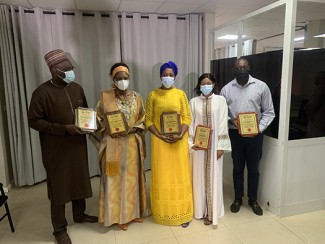
On July 13, 2021, the Gambia’s Truth, Reconciliation and Reparations Commission (TRRC) presented an award to ICTJ for its sustained support of the commission and its commitment to the country’s transitional justice process. The award comes as the TRRC concludes its work and prepares to submit its final report to the country’s president by September 30, 2021.

On June 25, President of the Philippines Rodrigo Duterte publicly proposed arming civilian supporters in his war on drugs. His statement comes barely a week after the International Criminal Court’s (ICC) outgoing prosecutor, Fatou Bensouda, announced her request to open an investigation into crimes against humanity related the Philippines’ war on drugs. This step has been long-awaited by victims of the drug war. Nonetheless, the ICC case should be part of a larger, more strategic fight for justice in which the needs, safety, and future of the predominantly poor families victimized by the drug war are central and just as important as naming, shaming, and prosecuting the perpetrators and abettors of these crimes.